Ford Motor Company, one of
the world’s largest manufacturers of automobiles and the world’s largest producer
of trucks. Under the leadership of its founder, Henry Ford, the company implemented
the assembly-line method of mass production and made cars affordable to middle-class
consumers. Ford is the second largest company in the United States based on
overall sales, trailing only General Motors Corporation. Ford is based in
Dearborn, Michigan.
Ford markets vehicles under
the brands of Ford, Lincoln, Mercury, Jaguar, and Aston Martin. In addition,
Ford owns the automobile division of Swedish car and truck manufacturer Volvo
and is a part owner of Japanese automaker Mazda Motor Corporation. Ford’s
subsidiaries include the Hertz Corporation, the world’s largest car rental
company, and Ford Credit, the world’s largest provider of automotive financing.
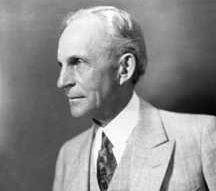
Henry Ford, an engineer with the Edison Illuminating Company in Detroit, experimented with engines in his spare time and completed his first automobile, the Quadricycle, in 1896. The vehicle consisted of a two-cylinder engine and chassis mounted on four bicycle wheels with no brakes. It had a top speed of 40 km/h (25 mph). By 1899 Ford had built two more models and gained recognition for his pioneering work. That year he founded the Detroit Automobile Company, but the company went bankrupt in 1901. Later that year Ford and other investors started the Henry Ford Company, but Ford was asked to resign after devoting too much time to building race cars. The company later became the Cadillac Automobile Company.
In 1903 the 40-year-old Ford and 11 investors raised $28,000 to form the Ford Motor Company. Among the original investors were brothers John and Horace Dodge, who would later found their own car company. In the first 15 months of operation, the Ford factory produced 1,700 Model A automobiles, which earned a reputation for reliability. Over the next five years Ford and his engineers produced other models, some purely experimental, designated with the letters B through S. The most successful of these models was the Model N, a small four-cylinder car priced at $500. The Model K, a $2,500 six-cylinder luxury model, was a financial failure.

The success of the Model N convinced Ford that the company’s future lay in producing inexpensive cars for a mass market. In 1908 Ford introduced the Model T, a sturdy four-cylinder car with an attractive design and a top speed of 72 km/h (45 mph). Priced at $850, the car created an immediate sensation, selling more than 10,000 in the first year. To keep up with demand, in 1913 Ford instituted an assembly-line system, in which each worker performed only one specialized task. This new technique allowed workers to assemble Model Ts in a fraction of the time required previously. By 1913 Ford had established assembly plants in Canada, Europe, Australia, South America, and Japan.
In 1914 Ford astonished the business world by more than doubling the minimum wage for his workers. He reasoned that if his employees earned more, the company would sell more cars to them and reduce employee turnover. By 1916 Ford had lowered the price of the Model T to about $350, making the cars affordable to the average worker. By the early 1920s more than half of all cars in the United States were Model Ts. In 1922 Ford purchased the Lincoln Motor Company, a maker of luxury cars.
Ford sales began to drop after competitors introduced larger and more luxurious cars. In 1927, with 15 million Model Ts sold, the company ceased production of the car and closed its plants for six months to retool for a new model, the Model A (named for the original). The Model A was a substantial improvement over the Model T, with features such as hydraulic shock absorbers, automatic windshield wipers, a gas gauge, and a speedometer. Between 1927 and 1931, Ford produced nearly 5 million Model A cars and trucks.
In 1937 supporters of unionization were physically beaten near a Ford plant by people suspected to be members of Ford’s security office. In response, the National Labor Relations Board cited the company for unfair labor practices. In 1941, following a massive workers’ strike, Henry Ford agreed to a contract that met workers’ demands and recognized the United Automobile Workers of America (UAW) as the collective bargaining representative for all Ford employees.
 After the United States entered
World War II in 1941, Ford shut down civilian automobile production and manufactured
B-24 bombers, aircraft engines, tanks, and other equipment for the military.
When the war ended, Ford resumed production of civilian vehicles.
After the United States entered
World War II in 1941, Ford shut down civilian automobile production and manufactured
B-24 bombers, aircraft engines, tanks, and other equipment for the military.
When the war ended, Ford resumed production of civilian vehicles.In the early 1950s the company introduced a series of moderately successful cars, including the Thunderbird, a two-seat sports car with a convertible canvas roof. But there were failures as well. The Edsel, introduced in 1958 and named after Henry Ford’s only son, lost $250 million.
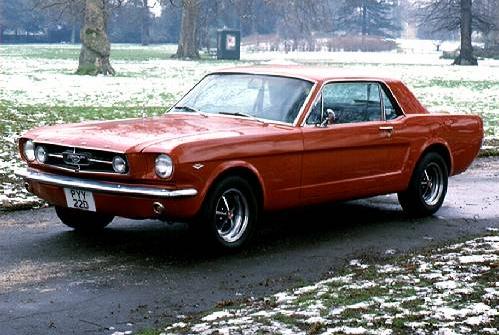
In 1964 the company rolled out the Mustang, a small, two-door car available with a convertible or hardtop roof. The car became enormously popular, with more than 418,000 sold in its first year on the market. In the mid-1970s Ford received unfavorable publicity following several accidents in which the gas tank of the subcompact Pinto exploded. Ford paid millions of dollars to settle lawsuits over Pinto accidents.
In the early 1980s the popularity
of Japanese compact cars surged, and Ford’s sales slipped. From 1980 to 1982
the company lost $3.2 billion. In 1985 the company introduced the Taurus,
which became one of the top-selling cars in the United States. In 1987 Ford
bought 75 percent of British luxury sports car manufacturer Aston Martin.
Two years later Ford spent $2.5 billion to acquire Jaguar, a British luxury
carmaker founded in the 1920s. Ford marked record profits in the late 1980s,
driven in part by strong sales of its subcompact Escort (introduced in 1980)
and its F-series pickup truck.
Ford again endured heavy losses
in the early 1990s, partly from poor sales of Jaguar products. By the mid-1990s,
however, Ford had regained profitability. In 1996 the company built its 250-millionth
vehicle. Hoping to increase its sales of higher-profit luxury cars, in 1999
Ford purchased the automobile division of Swedish car and truck manufacturer
Volvo. A year later, the company announced plans to acquire the Land Rover
line of luxury sport-utility vehicles from Bayerische Motoren Werken (BMW).